
Tax Defense ✦ Appeals & CDP Hearings
When the IRS Gets It Wrong, There’s a Referee.
The IRS Independent Office of Appeals exists to settle disputes before they become lawsuits, and the collection due process hearing is the single most powerful procedural right a taxpayer has. North Star Law Firm takes New Mexico audit disputes and collection fights to Appeals, and to the U.S. Tax Court when Appeals gets it wrong.
Your Referee
What is the Independent Office of Appeals?
Appeals is a separate function inside the IRS, walled off from the examiners and collection officers whose decisions it reviews. Its officers settle cases based on the hazards of litigation: the probability the government would lose some or all of an issue in court. That standard is why represented taxpayers do well there. An appeal is not a plea for mercy; it is a lawyer’s argument about what a judge would do, backed by a file that proves it.
Two doors lead in. Audit disputes arrive by written protest after the examination report. Collection disputes arrive through hearing requests that specific notices unlock, and those windows are short, fixed, and unforgiving.
Know Your Hearing
CDP, equivalent, or CAP: which hearing do you have?
| Hearing | Trigger and deadline | What it gets you |
|---|---|---|
| Collection due process (§ 6320, § 6330) | 30 days from a lien notice or Final Notice of Intent to Levy | Levy action generally freezes; collection alternatives heard; U.S. Tax Court review if denied |
| Equivalent hearing | Within one year after the CDP window is missed | The same Appeals conference, but no levy freeze and no Tax Court review |
| Collection Appeals Program | Before or after many collection actions; very fast | Quick review of a specific action; no court review and narrower scope |
The gap between the first two rows is the most expensive missed deadline in tax controversy. A timely CDP request preserves court review; a late one forfeits it forever.
What can actually be raised at a CDP hearing?
More than most taxpayers expect. Collection alternatives are the everyday work: installment agreements, offers in compromise, hardship status, lien withdrawals. Procedural challenges are heard: whether notices were properly issued, whether the collection statute has run. And where you never had a prior chance to dispute the tax itself, the underlying liability can be contested. The hearing turns a collection steamroller into a structured negotiation with an officer who has authority to say yes.
What happens if Appeals says no?
A CDP determination is reviewable in the U.S. Tax Court, generally on a 30-day clock. That right is what gives the hearing its teeth, and it is why the administrative record we build at the hearing matters so much: the court reviews what Appeals had in front of it. Files built casually lose twice.
The Attorney-CPA Difference
Appeals is where prepared cases settle. Bring a prepared case.
- Protests and hearing requests filed inside the deadlines that preserve court review
- Hazards-of-litigation arguments written the way Appeals officers evaluate them
- Financial packages for collection alternatives built by a CPA
- Tax Court review ready from day one, because the record we build assumes it
Proof, In Print
He wrote the book on tax defense. Literally.
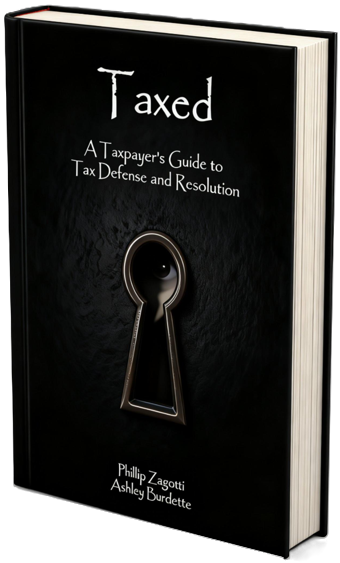
Phillip Zagotti co-authored Taxed: A Taxpayer’s Guide to Tax Defense and Resolution with Ashley Burdette, a plain-English guide to audits, IRS collections, and the resolution tools described on this page. If you want to understand your situation before you call anyone, or you’d rather work the problem yourself first, start with the book. When you decide you want a professional in your corner, the consultation is free.
Questions & Answers
Appeals and CDP questions, answered
I got a Final Notice of Intent to Levy. How long do I have?
Thirty days from the notice date to request a collection due process hearing. Filing on time generally freezes levy action while the case is heard and preserves Tax Court review. This deadline is the one to drop everything for.
I missed the 30-day window. Is it over?
Not entirely. Within a year you can request an equivalent hearing, which gets you the same Appeals conference but without the levy freeze or court review. The other resolution tools remain available too. It’s worse, not hopeless.
How long does an appeal take?
Audit appeals commonly run several months to a year depending on Appeals staffing and case complexity. CDP cases move on their own track. Slow is not bad: interest accrues, but collection is generally not pounding on the door while a CDP case pends.
Do I need a lawyer for Appeals, or can my preparer handle it?
Appeals settles on litigation risk, which is an assessment of what a court would do with the law and the record. That is attorney work, and attorney-client privilege covers the strategy conversations. The CPA half matters too: most Appeals cases are won or lost on the quality of the financial package.
Can Appeals reduce penalties?
Yes, penalty abatement is squarely within Appeals’ settlement authority, and hazards arguments on reasonable cause are often stronger there than with the original function that assessed the penalty.
The clock on your appeal rights is already running.
Free consultation with an attorney-CPA: which hearing your notice unlocks, what it can get you, and what the file needs before the deadline.