
Tax Defense ✦ Innocent Spouse Relief
Your Ex’s Tax Debt Doesn’t Have to Be Yours.
A joint return makes both spouses liable for every dollar, even after divorce, and even when one spouse hid the income that caused the bill. Federal law gives the other spouse a way out. North Star Law Firm handles innocent spouse and community property relief for New Mexico taxpayers, from Form 8857 through the U.S. Tax Court.
The Problem
Why are you on the hook for a spouse’s tax mistakes?
Joint and several liability. When a married couple signs a joint return, each spouse becomes responsible for the entire tax, penalties, and interest, not just their share. The IRS can pursue whichever spouse is easier to collect from, and it often does exactly that, long after a separation or divorce. The typical client did not prepare the return, did not control the business or the accounts that produced the problem, and learned about the debt from a collection notice years later.
New Mexico adds a wrinkle most national articles skip: it is one of nine community property states. Community property rules can pull one spouse’s income onto the other’s return even when the couple files separately, which means New Mexicans can face a version of this problem that separate filing alone does not fix. Congress wrote a specific answer for that situation, and it sits alongside the three better-known forms of innocent spouse relief.
The Four Paths
What kinds of relief exist, and which one fits?
All four run through the same starting gate, Form 8857, but they have different tests, different deadlines, and different payoffs. Choosing the right theory at the start, and building the record for it, is most of the representation.
| Relief | Authority | Core test | Deadline |
|---|---|---|---|
| Traditional innocent spouse | I.R.C. § 6015(b) | Understatement caused by the other spouse’s erroneous items; you didn’t know and had no reason to know; holding you liable would be inequitable | 2 years from first IRS collection activity against you |
| Separation of liability | I.R.C. § 6015(c) | Divorced, legally separated, or living apart 12+ months; the deficiency is split by who earned the items | 2 years from first collection activity |
| Equitable relief | I.R.C. § 6015(f) | Fairness factors: hardship, abuse, knowledge, benefit, compliance; the only path for tax that was reported but never paid | Any time the collection statute is open (refund claims follow refund deadlines) |
| Community property relief | I.R.C. § 66(c) | For separate filers in community property states like New Mexico taxed on a spouse’s community income they didn’t know about or benefit from | Raised on Form 8857; equitable version follows § 6015(f) timing |
What does “reason to know” actually mean?
This is where most cases are won or lost. The IRS asks whether a reasonable person in your position would have known of the understatement: your education and business experience, your involvement in the family finances, unusual spending you saw or shared in, and how the erroneous items compare to the household’s visible lifestyle. Signing the return is not fatal. Neither is having seen the mail. What matters is the picture the whole record paints, which is why the strongest requests are built like small trial files: financial reconstructions, account records, communications, and a declaration that tells the story precisely. As an attorney-CPA practice, we build both halves of that file, the numbers and the narrative, under one privilege.
How does New Mexico community property law change the analysis?
In a community property state, income earned by either spouse during the marriage generally belongs to both, and each spouse filing separately is normally taxed on half of the community income. That rule can attach a spouse’s hidden earnings to your separate return even though you never saw a dollar of them. Section 66(c) undoes that result when you didn’t know about the income, had no reason to know, and it would be unfair to tax you on it, with an equitable fallback that parallels § 6015(f). Divorcing New Mexicans should also understand the flip side: property division and debt allocation in the decree do not bind the IRS, so relief has to come from the federal statutes, not the divorce court.
What does the process look like?
Form 8857 opens the case. The IRS’s specialized unit reviews it, contacts the other spouse (the law requires it), and issues a preliminary and then a final determination, a process that commonly runs six months or more. A denial can be appealed administratively, and § 6015(e) then provides review in the U.S. Tax Court, generally on a 90-day clock from the final determination. Collection against you is generally suspended while a § 6015 request is pending, which by itself brings breathing room many clients haven’t had in years. Where the request is strong, we push for full relief and refunds of amounts already taken where the statute allows them.
Why It Goes to a Professional
These cases are records contests. Build the record right.
- Theory selection first: (b), (c), (f), or § 66(c), each with different proof and deadlines
- Financial reconstruction by a CPA that shows what you knew, saw, and benefited from
- Abuse and financial-control facts presented properly; they change the knowledge analysis
- A file built for Tax Court review from day one, not patched together after a denial
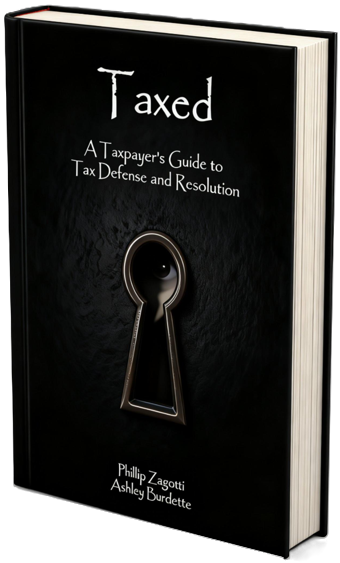
Proof, In Print
He wrote the book on tax defense. Literally.
Phillip Zagotti co-authored Taxed: A Taxpayer’s Guide to Tax Defense and Resolution with Ashley Burdette, a plain-English guide to audits, IRS collections, and the resolution tools described on this page. If you want to understand your situation before you call anyone, or you’d rather work the problem yourself first, start with the book. When you decide you want a professional in your corner, the consultation is free.
Questions & Answers
Frequently asked questions about innocent spouse relief
Do I qualify if I signed the joint return?
Signing the return does not disqualify you. Innocent spouse relief exists precisely for people who signed joint returns. What matters is whether you knew or had reason to know of the understatement, whether the erroneous items belong to your spouse, and whether holding you liable would be unfair under all the circumstances.
How long do I have to request relief?
For relief under § 6015(b) and (c), generally two years from the date the IRS first begins collection activity against you. Equitable relief under § 6015(f) can be requested any time the collection statute remains open, or within the refund period if you are seeking money back. The safest answer is to file Form 8857 as soon as the problem surfaces.
Does a divorce decree saying my ex pays the taxes protect me from the IRS?
No. A divorce decree binds you and your ex-spouse, not the federal government. The IRS can collect a joint liability from either spouse regardless of what the decree says. The decree can matter as a factor in equitable relief, and it may give you a claim against your ex, but it is not a defense to IRS collection by itself.
Will the IRS contact my ex-spouse if I apply?
Yes. The law requires the IRS to notify the other spouse and give them a chance to participate, and they can appeal a grant of relief. There is no way around the notification, but the IRS does not disclose your address or personal information, and domestic violence concerns can be raised on the form itself.
What if the IRS denies my request?
A denial is not the end. You can appeal within the IRS, and § 6015(e) gives you the right to petition the U.S. Tax Court, generally within 90 days of the final determination. The Tax Court reviews equitable relief claims on a fresh record, which makes a well-built administrative file doubly valuable.
Is injured spouse relief the same thing?
No, and mixing them up wastes months. Injured spouse relief (Form 8379) recovers your share of a refund that was seized for your spouse’s separate debt, like their old taxes or child support. Innocent spouse relief (Form 8857) removes your liability for tax on a joint return. Different forms, different rules, different outcomes.
You didn’t create this debt. You don’t have to carry it.
A free, confidential review with an attorney-CPA, including which of the four relief paths fits your facts and what the record needs to show.