
Tax Defense ✦ Offer in Compromise
Settle With the IRS for What You Can Actually Pay.
An offer in compromise lets qualifying taxpayers settle a federal tax debt for less than the balance. It is not a slogan and it is not luck; it is a formula the IRS must follow. North Star Law Firm runs that formula for New Mexico taxpayers before anyone pays a fee, then builds the offer the numbers support.
How It Really Works
What is an offer in compromise?
Under I.R.C. § 7122, the IRS may compromise a tax liability, and it accepts thousands of offers every year. Acceptance turns on one number: your reasonable collection potential, the equity in what you own at quick-sale value plus a multiple of your monthly disposable income under the IRS’s own expense standards. When the offer equals or beats that number, the government takes the deal, because the formula says it will never collect more. When it doesn’t, no amount of hardship storytelling closes the gap.
That makes offer work an accounting exercise wrapped in a legal procedure, which is exactly the combination this practice is built around. We compute your reasonable collection potential first, in the free consultation. If the math supports an offer, we prepare Form 656 and the financial disclosures to survive scrutiny. If it doesn’t, we tell you that day and point you at the tool that actually fits, whether that is a partial-pay installment agreement, hardship status, or a bankruptcy discharge analysis.
Three Doors
Which type of offer fits your case?
| Offer type | The argument | Best fit |
|---|---|---|
| Doubt as to collectibility | You can never realistically pay the full balance before the collection statute expires | Most consumer and small-business offers; pure math |
| Doubt as to liability | You don’t actually owe the tax: bad audit, identity issues, assessment errors | Disputed assessments where the underlying tax is wrong |
| Effective tax administration | You could technically pay, but collection would be inequitable or create hardship | Rare cases: elderly or disabled taxpayers, special circumstances |
For the full arithmetic, worked through a New Mexico example with real numbers, read our companion guide: The Real Math Behind an IRS Offer in Compromise.
What does the offer process look like?
An offer is filed on Form 656 with a full financial disclosure package and a nonrefundable application fee and deposit. The IRS assigns it to an offer examiner, who tests every number against the collection standards, questions asset values, and often counters. The process commonly runs six to twelve months. Collection generally pauses while the offer is pending, but so does the ten-year collection statute, which is why we check the statute dates on your transcripts before recommending an offer at all. Some clients are two years from the debt expiring on its own; filing an offer would be a gift to the government.
Why do so many offers fail?
Four reasons dominate. The taxpayer wasn’t filing-compliant, so the offer came back unprocessed. The offer was priced on hope instead of the formula. Dissipated assets, money spent on non-priority items after the debt arose, got added back into the calculation. Or a new tax debt accrued while the offer was pending, which defaults everything. Every one of those failures is avoidable with transcript work and honest math on the front end, which is precisely the part the late-night-radio offer mills skip.
The Attorney-CPA Difference
Offer work is math first, advocacy second. We do both.
- Reasonable collection potential computed by a CPA before you spend a dollar on filing fees
- Asset valuations and expense positions documented to survive the offer examiner
- Statute-of-limitations check first, so an offer never revives a debt that was about to die
- Appeal rights preserved and used when an examiner gets the numbers wrong
Proof, In Print
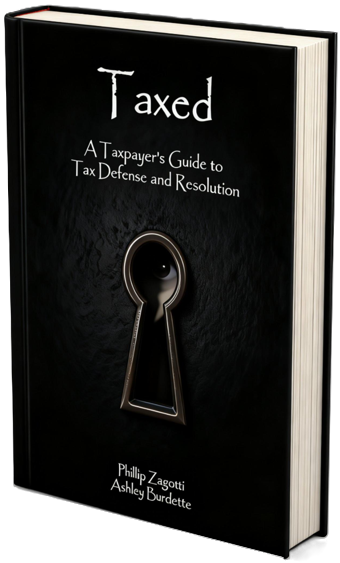
He wrote the book on tax defense. Literally.
Phillip Zagotti co-authored Taxed: A Taxpayer’s Guide to Tax Defense and Resolution with Ashley Burdette, a plain-English guide to audits, IRS collections, and the resolution tools described on this page. If you want to understand your situation before you call anyone, or you’d rather work the problem yourself first, start with the book. When you decide you want a professional in your corner, the consultation is free.
Questions & Answers
Offer in compromise questions we hear most
How much should I offer the IRS?
Exactly what the formula produces: net realizable equity in your assets plus 12 or 24 months of disposable income, depending on payment structure. Offering less invites rejection; offering more wastes money. The free consultation includes a first pass at that number.
Do I qualify if I own a home?
Often, yes. Home equity counts at 80 percent of market value minus the mortgage, so modest equity adds little to the required offer. Substantial equity raises the price of the offer but doesn’t automatically disqualify you; it changes the math.
Will an offer stop collection while it’s pending?
Generally yes. Levy action pauses while a processable offer is under review, and that protection is itself worth something. The trade-off is that the collection statute pauses too, so the decision should always follow a transcript review.
What happens after an offer is accepted?
You pay the offer amount on the agreed schedule and stay filing-and-payment compliant for five years. Default the compliance condition and the IRS can reinstate the original debt minus payments, so the engagement includes setting you up to stay clean.
Can I do this myself with the IRS pre-qualifier tool?
The online pre-qualifier screens simple cases decently. What it can’t do is value a small business, defend above-standard expenses, spot dissipated-asset addbacks, or compare the offer against the statute clock and bankruptcy. Our book, Taxed, walks through the do-it-yourself version honestly, including where the tripwires are.
Find out what the formula says, free.
A confidential reasonable-collection-potential analysis with an attorney-CPA. If an offer fits, you’ll know the number. If it doesn’t, you’ll know the better tool.