
Tax Defense ✦ Penalty Abatement
The Penalties Are Often the Biggest Number. And the Most Removable.
On many IRS balances, penalties and the interest on them approach half the total. Federal law removes penalties for taxpayers with clean histories or good reasons, and in 2026 part of that relief became automatic. North Star Law Firm gets penalties abated for New Mexico taxpayers and businesses.
Where the Balance Came From
Which penalties are you actually carrying?
Most individual balances stack three charges. The failure-to-file penalty under I.R.C. § 6651 runs 5 percent of the unpaid tax per month to a 25 percent cap, the failure-to-pay penalty runs 0.5 percent monthly to its own 25 percent cap, and interest compounds daily on all of it, penalties included. Business balances add the failure-to-deposit penalty on payroll taxes, and audits add accuracy-related penalties of 20 percent under § 6662. The arithmetic is the point: abate a penalty and the interest charged on it falls away too, which is why penalty work often shrinks a balance faster than any payment plan.
The Relief Map
What are the paths to removing penalties?
| Path | The test | Notes |
|---|---|---|
| Automatic Exemption from Penalty | Clean compliance history; applied automatically by the IRS | New in 2026: replaces First Time Abatement for eligible failure-to-file, failure-to-pay, and deposit penalties, starting with 2025-2026 periods |
| First-time abatement (legacy) | Clean three-year history; must be requested | Still the tool for older tax years as AEP phases in |
| Reasonable cause | Ordinary business care despite illness, disaster, records loss, reliance on advice | Fact-driven; won with documentation and precise narrative |
| Statutory and procedural defenses | Penalty assessed without required approvals or against the statute | Supervisory-approval and notice defects still void real penalties |
| Appeals settlement | Hazards of litigation on any of the above | Penalty issues settle at Appeals constantly |
What does a winning reasonable-cause case look like?
Specific, documented, and matched to the timeline. The standard asks whether you exercised ordinary business care and still couldn’t comply, and the IRS evaluates it against dates: what happened, when, and how it maps onto each period a penalty covers. Serious illness with medical records. A disaster declaration covering your county. A preparer’s error you reasonably relied on, with the engagement letter to prove it. Generic hardship letters fail; precise chronologies with exhibits succeed. Building that file is exactly the intersection of accounting and advocacy this practice occupies.
Does the new automatic relief mean you can skip the professional?
Sometimes, and we’ll tell you when. The Automatic Exemption from Penalty the IRS announced in July 2026 grants clean-history relief without a request, but it reaches specific penalties and recent periods. It does nothing for accuracy penalties, older years still governed by first-time abatement, multi-year pileups, or reasonable-cause facts. The free review sorts your balance into what falls off automatically, what needs a request, and what needs a fight.
The Attorney-CPA Difference
Penalties are removed by files, not by phone-call charm.
- Transcript analysis that maps every penalty, period, and interest accrual
- Reasonable-cause files built like legal briefs: chronology, exhibits, authority
- Procedural defenses checked on every assessed penalty
- Refund claims filed where abatable penalties were already paid
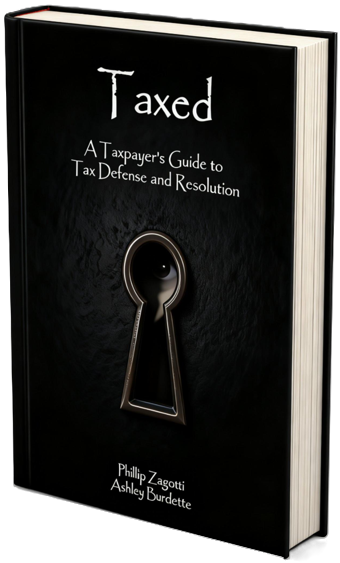
Proof, In Print
He wrote the book on tax defense. Literally.
Phillip Zagotti co-authored Taxed: A Taxpayer’s Guide to Tax Defense and Resolution with Ashley Burdette, a plain-English guide to audits, IRS collections, and the resolution tools described on this page. If you want to understand your situation before you call anyone, or you’d rather work the problem yourself first, start with the book. When you decide you want a professional in your corner, the consultation is free.
Questions & Answers
Penalty abatement questions, answered
How much of my balance is penalties?
Frequently 25 to 45 percent once interest-on-penalties is counted, and you can’t tell from the notices alone. Account transcripts itemize every assessment, which is why every engagement here starts by pulling them.
I already paid the penalties. Is it too late?
Not necessarily. Abatable penalties that were paid can be recovered through refund claims within the refund statute, generally the later of three years from filing or two years from payment. Paid-and-forgotten penalties are recoverable money.
Does owing the tax stop me from getting penalties removed?
No. Penalty relief and payment of the tax are separate questions, and abatement often makes the remaining balance small enough for a manageable plan. Removing penalties first, then structuring payment, is the normal order of operations.
What about New Mexico state penalties?
The Taxation and Revenue Department has its own penalty and interest rules and its own abatement standards, and the managed-audit and protest procedures can reach them. Federal relief doesn’t transfer automatically, so both tracks get worked.
Is interest ever abatable?
Rarely, and mostly where IRS errors or delays caused it. But interest charged on an abated penalty comes off with the penalty, which is where most interest reduction actually comes from.
Find out what should never have been on your balance.
Free penalty review with an attorney-CPA: transcript pull, penalty map, and the realistic abatement plan.