
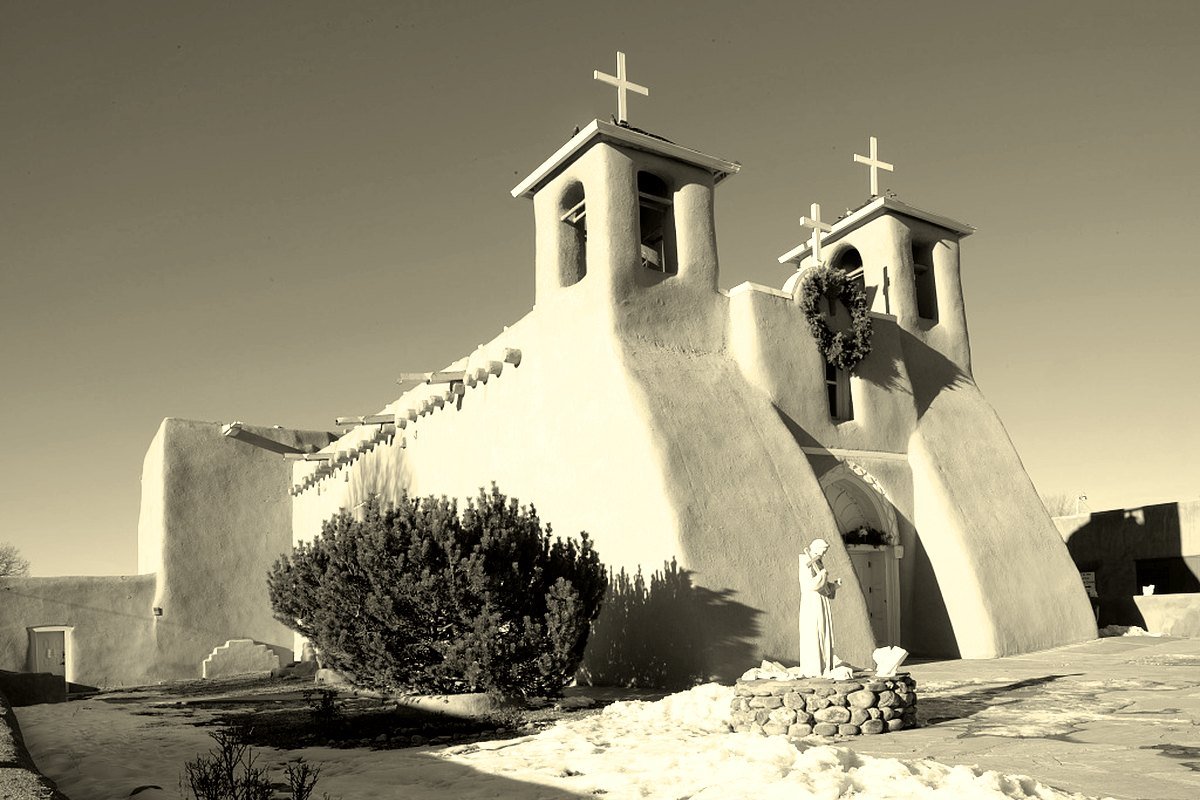
Picture a social-services nonprofit in Gallup whose board is appointed by the local Catholic bishop. It runs a food pantry and a housing-assistance desk with 14 people on payroll, and it has paid New Mexico unemployment contributions every quarter since it opened. Now a board member has read that the U.S. Supreme Court sided with a diocesan charity in Wisconsin on the same tax.
Should the Gallup group stop paying? Not automatically. The case set a constitutional limit on how states read their religious-employer exclusions. Whether a New Mexico ministry fits our exclusion is still a state-law question, under a statute that borrows the Wisconsin words almost exactly.
Does New Mexico exempt church-controlled nonprofits from state unemployment tax?
It can. The New Mexico Unemployment Compensation Law brings nonprofit work into coverage in NMSA 1978, § 51-1-42(F)(8), which reaches service for “a religious, charitable, educational or other organization” that federal law leaves out. Paragraph (12) then takes some of it back. Under § 51-1-42(F)(12)(a), “employment” does not include service for a church or convention or association of churches, or for “an organization that is operated primarily for religious purposes and that is operated, supervised, controlled or principally supported by a church or convention or association of churches.” Subparagraph (b) separately excludes ministers performing their ministry.
That is the Wisconsin test nearly word for word, down to the phrase the Supreme Court had in front of it. Both halves matter: church control alone is not enough, and a devout charity with no church behind it does not qualify either.
I searched for a New Mexico appellate decision or a Tenth Circuit opinion applying this paragraph and found none. Disputes start with the Department of Workforce Solutions, which under § 51-1-13(A)(4) notifies nonprofits of their status and allows reconsideration and appeal.
Why does New Mexico’s exemption copy FUTA § 3309(b)(1)?
Because the federal statute wrote the words first. The Federal Unemployment Tax Act imposes a 6 percent tax on the first $7,000 of each employee’s wages (26 U.S.C. § 3301; § 3306(b)(1)), but § 3306(c)(8) takes work for a 501(c)(3) organization out of federal “employment” altogether. No 501(c)(3), church or not, pays FUTA.
Congress did not let charities skip unemployment coverage, though. Section 3309(a) tells each state what its law must do for 501(c)(3) employees: cover them, and under § 3309(a)(2) let those employers pay “in lieu of” contributions, reimbursing the fund for benefits actually drawn. Then § 3309(b)(1) carves out churches, religious elementary and secondary schools, and organizations “operated primarily for religious purposes” that a church operates, supervises, controls or principally supports. Since 1970, the Court noted, “over 40 States have adopted similar exemptions,” New Mexico among them.
So the religious carve-out is purely a state question. Federally, a church-run pantry and a secular food bank are already treated alike.
What did Catholic Charities Bureau v. Wisconsin actually hold?
In Catholic Charities Bureau, Inc. v. Wisconsin Labor & Industry Review Commission, 605 U.S. ___ (2025) (No. 24-154, June 5, 2025), a unanimous Court, per Justice Sotomayor, held that the Wisconsin Supreme Court’s application of the exemption violated the First Amendment. The Wisconsin court had denied the exemption because the charities did not proselytize and served people of every faith. That approach, the opinion said, “grants a denominational preference by explicitly differentiating between religions based on theological practices.” Drawing lines that way is “textbook denominational discrimination,” and it triggers strict scrutiny. Wisconsin’s two asserted interests, broad coverage and avoiding entanglement, failed it; the charities ran their own unemployment program, and the exemption covered “both the janitor and the priest in equal measure.”
The holding is narrow. Footnote 2 confines it to the denominational neutrality challenge, and the Court did not define “operated primarily for religious purposes.” The rule it applied comes from Larson v. Valente, 456 U.S. 228 (1982): one denomination may not be officially preferred over another. Justice Thomas would also have treated the charity as an arm of the diocese under church law. Justice Jackson read the federal phrase functionally, as turning on “what an entity does, not how or why it does it.”
On remand, the Wisconsin Supreme Court’s December 15, 2025 order directed the commission to declare the charities eligible.
How can New Mexico read “operated primarily for religious purposes” after Catholic Charities?
With care. Nothing in the opinion forbids the Department of Workforce Solutions from looking at what an organization does; the statutory question stays open. What an agency or court cannot do is decide eligibility by asking whether the ministry evangelizes or serves only its own members. Those are theological choices, and a test that rewards one tradition’s choices over another’s must survive strict scrutiny. Wisconsin’s did not.
St. Martin Evangelical Lutheran Church v. South Dakota, 451 U.S. 772 (1981), read “church” in § 3309(b)(1)(A) to mean the congregation or hierarchy, so a school with no separate corporate existence was the church. A separately incorporated affiliate like our Gallup group must clear the “primarily religious” test instead. The Jackson concurrence previews what a state could still argue: an activity-based reading applied evenhandedly to every faith. New Mexico’s answer is unsettled.
Exempt, reimbursing, or contributing: what does each cost a Gallup nonprofit?
Illustration only. Assume all 14 employees earn more than the 2026 New Mexico taxable wage base of $34,800 (the figure national payroll publishers report; confirm it with the department before relying on it). Taxable wages are 14 times $34,800, or $487,200.
As a contributing employer, under § 51-1-11, the group pays its industry’s average new-employer rate, never less than 1 percent, and experience-rated employers range from 0.33 to 5.4 percent. At the 1 percent floor the bill is $4,872 a year. At 5.4 percent it would be about $26,309.
As a reimbursing employer under § 51-1-13, it must post a bond or cash deposit equal to 2.7 percent of taxable wages, about $13,154 here, payable in three annual installments with the secretary’s consent. With no benefit charges in the prior year, it prepays one-eighth of 1 percent each quarter, $609. Now suppose a grant ends and two laid-off case managers draw an assumed $11,000 in benefits. The group is billed the full $11,000, and later quarterly prepayments become 25 percent of charges in the four quarters ending the preceding June 30, $2,750 a quarter. Reimbursing is cheaper in quiet years, dearer in a layoff year.
If the group is exempt under paragraph (12), it pays nothing, and those two case managers have no New Mexico claim based on their work there. Section 51-1-18(D) lets an employing unit elect coverage for services that are not “employment,” for at least two calendar years, with the secretary’s written approval. Whether a voluntarily covered ministry can then use the reimbursing method is a question to put to the department.
Does the unemployment exemption change FICA, 501(c)(3) status, or Form 990?
No, and boards often get confused here. Under 26 U.S.C. § 3121(b)(8)(B), work for a church or a qualified church-controlled organization escapes FICA only if the employer made a § 3121(w) election, certifying that it opposes the tax for religious reasons, on Form 8274 before its first quarterly employment tax return was due. Employees of an electing employer then owe self-employment tax on church employee income of $108.28 or more (§ 1402(a)(14), (j)). A church-controlled charity that sells services to the public and normally receives more than 25 percent of its support from government or fees cannot elect at all.
Filing follows yet another test. Section 6033(a)(3)(A)(i) excuses “churches, their integrated auxiliaries, and conventions or associations of churches” from Form 990. Under Treas. Reg. § 1.6033-2(h), an affiliate that sells services to the public and gets more than half its support from government grants, public solicitation and program receipts is not internally supported, so it files. The Gallup group could be exempt from state unemployment tax and still file a 990; the firm’s post on the Form 990 rewrite for grants and fiscal sponsors covers that return’s coming changes. Lose 501(c)(3) status, and § 3306(c)(8) no longer shields the group from FUTA; see what to do after a 501(c)(3) revocation.
| Tax or filing | Church (parish, convention) | Church-controlled charity | Secular 501(c)(3) |
|---|---|---|---|
| FUTA | Not subject (§ 3306(c)(8)) | Not subject (§ 3306(c)(8)) | Not subject (§ 3306(c)(8)) |
| New Mexico UI | Excluded, § 51-1-42(F)(12)(a); voluntary election possible | Excluded only if “operated primarily for religious purposes”; otherwise contributing or reimbursing | Covered; contributing or reimbursing under § 51-1-13 |
| FICA | Applies unless a § 3121(w) election is in effect | Applies unless a qualifying § 3121(w) election is in effect | Applies |
| Form 990 | Not required (§ 6033(a)(3)(A)(i)) | Required unless an integrated auxiliary | Required (990, 990-EZ or 990-N) |
Frequently Asked Questions
Does Catholic Charities Bureau v. Wisconsin automatically exempt New Mexico church charities from unemployment tax?
No. The Court decided how a state may not read its exclusion, not who qualifies under New Mexico’s statute. Each organization still has to satisfy both prongs of § 51-1-42(F)(12)(a).
Does New Mexico’s exclusion use the same “operated primarily for religious purposes” language?
Yes. Paragraph (12)(a) uses that phrase and pairs it with operation, supervision, control or principal support by a church. The wording tracks FUTA § 3309(b)(1)(B) and the Wisconsin statute the Court reviewed.
What is a reimbursing employer in New Mexico?
A nonprofit that elects under § 51-1-13 to repay the fund for benefits its former employees draw, instead of paying a rate. It must post security and keep the election at least two taxable years.
If a ministry is exempt, can its laid-off employees collect unemployment?
Not on wages from excluded service. The organization can apply for voluntary coverage under § 51-1-18(D), which requires the secretary’s approval and lasts at least two calendar years.
Does the unemployment exemption affect FICA withholding?
No. FICA applies to churches and church-controlled organizations unless they made a timely § 3121(w) election on Form 8274. The two exemptions use different tests and different agencies.
How North Star Law Firm Can Help
North Star Law Firm advises New Mexico nonprofits and their boards on federal tax law questions about payroll taxes and information returns, including how an entity structure affects which taxes apply. When the IRS questions an employment tax position or a filing exemption, the firm handles the tax defense work.
Phillip Zagotti, JD/CPA, represents taxpayers before the IRS and the U.S. Tax Court and is admitted to the U.S. District Court and Bankruptcy Court for the District of New Mexico. The firm works alongside New Mexico-licensed counsel on state-law questions. If your church-affiliated nonprofit is weighing its unemployment and payroll tax status, contact North Star Law Firm.