
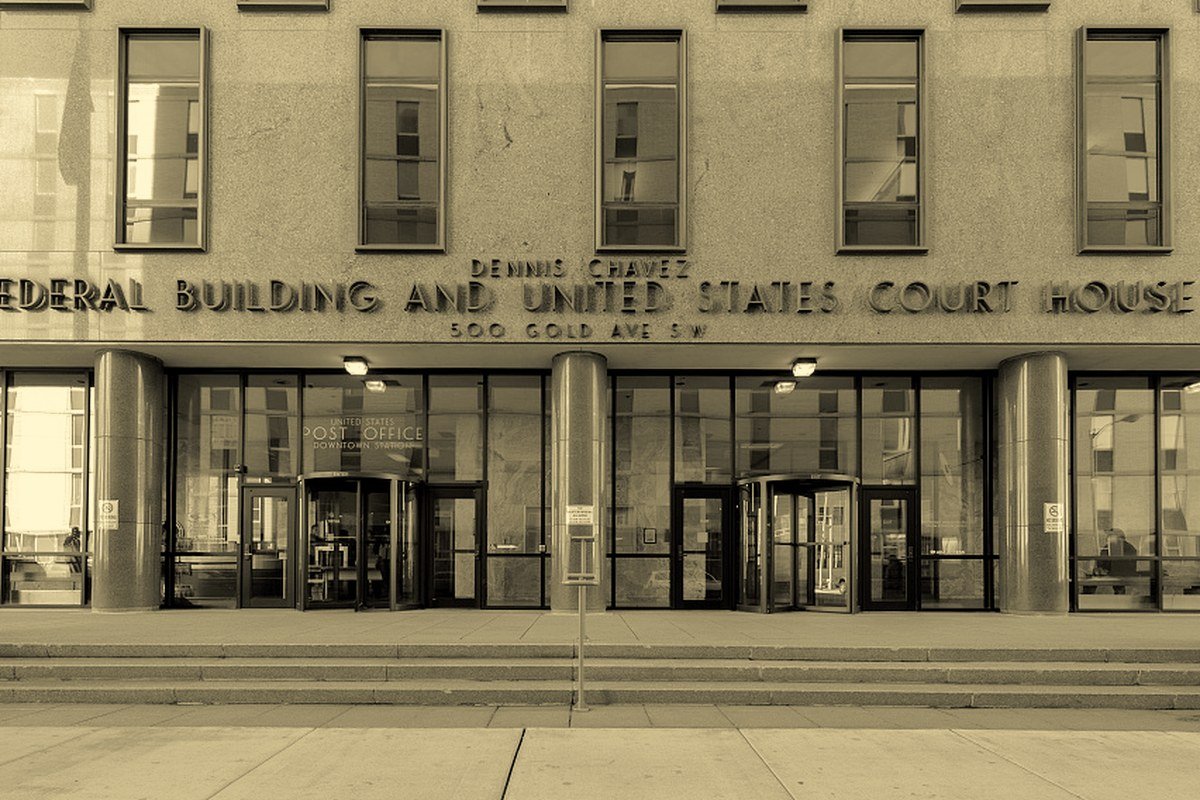
The Supreme Court’s opinion in Keathley v. Buddy Ayers Construction, Inc., 608 U.S. ___, No. 25-6 (U.S. June 11, 2026), singles out the Tenth Circuit, citing a 2007 Wyoming railroad case in footnote 3, as following the same rule the Court went on to reject. For nearly two decades that rule governed federal courts in New Mexico when a plaintiff’s bankruptcy omitted the lawsuit.
On August 31, a federal judge in Oklahoma City applied the new standard and barred the debtor anyway. The repair work happens mostly in bankruptcy court.
What did the Supreme Court actually decide in Keathley?
Thomas Keathley was in a confirmed Chapter 13 plan when he collided with a Buddy Ayers Construction driver. He told his bankruptcy lawyer he planned to sue, but nobody amended his schedules until the company moved for summary judgment on judicial estoppel. The lower courts applied Fifth Circuit precedent: an omission was inadvertent only if the debtor did not know the facts behind the claim or had no motive to conceal it.
Writing for a unanimous Court, Justice Jackson held that courts “should look to the totality of the circumstances surrounding the omission.” Because nearly every debtor knows of his claim and could gain by hiding it, “A near-dispositive criterion is a poor fit.” The Court assumed, without deciding, that judicial estoppel applies in bankruptcy, and footnote 5 left open whether bad faith is required. The framework is still New Hampshire v. Maine, 532 U.S. 742, 750-51 (2001), and its three factors.
Justice Thomas, joined by Justice Gorsuch, wrote that “In a future case, this doctrine merits a closer look.” Justice Sotomayor stressed that estoppel “provides one remedy and one remedy only: dismissal of the tort claim,” which tends to hurt creditors.
Why does Keathley land hardest on Tenth Circuit judicial estoppel law?
The Tenth Circuit case the Court cited was Eastman v. Union Pacific R.R. Co., 493 F.3d 1151 (10th Cir. 2007), where a debtor took a no-asset Chapter 7 discharge during a pending injury suit. Where knowledge and motive coexist, the panel said, courts “routinely, albeit at times sub silentio, infer deliberate manipulation.” Id. at 1157. Queen v. TA Operating, LLC, 734 F.3d 1081, 1093-94 (10th Cir. 2013), applied the same inference and held the debtors bound by their bankruptcy lawyer’s acts. In Anderson v. Seven Falls Co., No. 16-1377 (10th Cir. June 12, 2017) (unpublished), the panel refused to adopt the Ninth Circuit’s subjective-intent approach from Ah Quin, a decision the Supreme Court has now cited with approval.
The Eastman inference survives as evidence but dies as a shortcut. A federal court must now also weigh who prepared the schedules and how quickly the debtor fixed them.
Unlisted lawsuit or judicial estoppel motion? Contact Us Now
What did Gaines v. Halliburton hold about the debtor and the trustee?
In Gaines v. Halliburton Energy Services, Inc., No. CIV-25-661-R (W.D. Okla. Aug. 31, 2026), the court applied Keathley using the Eleventh Circuit’s factor list from Slater. She had bankruptcy counsel. She answered “No” on Schedule A/B, question 33, whose examples include accidents, while listing a garnishment case elsewhere. She sought to reopen only after defense counsel found the bankruptcy, and filed nothing in four months. Following Queen, the court found Oklahoma’s $50,000 injury exemption appeared to leave at least $25,000 exposed.
Filed before the petition, the claim was estate property, making the trustee the proper plaintiff under Fed. R. Civ. P. 17(a)(3). Finding no inconsistent conduct by the trustee, the court estopped only the plaintiff and held off entering judgment for sixty days, to about October 30, 2026, so the trustee could join. The plaintiff was told to send the trustee the order.
How does a New Mexico debtor reopen a closed Chapter 7 case to fix an omitted claim?
Under 11 U.S.C. § 541(a)(1), a claim existing on the petition date belongs to the estate, lawsuit filed or not. Closing abandons only scheduled property under § 554(c); § 554(d) keeps the rest in the estate.
The fix is a motion in the District of New Mexico bankruptcy court under § 350(b) and Fed. R. Bankr. P. 5010, which permits reopening “to administer assets.” A trustee is appointed only if the court finds one needed. Amended Schedules A/B and C follow under Rule 1009(a), restarting the 30-day objection window of Rule 4003(b).
The trustee may prosecute or settle the claim, sell it under § 363(b), or abandon it under § 554(a). In Eastman, the trustee paid creditors and abandoned the claim back to the debtor, who was then estopped. 493 F.3d at 1155 n.3. In Anderson, a claim pleaded above $5 million was capped at $45,662.04, roughly what creditors and fees required. And in Baker v. Bank of New York Mellon (In re Baker), Adv. No. 11-1131 (Bankr. D.N.M. Oct. 2013), Judge Thuma refused to let the Chapter 7 trustee substitute in mid-trial after the debtors had eight years and four bankruptcy lawyers to fix the omission.
Can a New Mexico debtor still exempt part of a personal injury recovery?
Filers may choose the federal list in § 522(d), whose capped bodily injury exemption excludes pain and suffering, or New Mexico’s list. NMSA 1978, § 42-10-1, rewritten in 2023, has no line for tort claims. Candidates are the $15,000 allowance for “any personal property, tangible or intangible” in Subsection (A)(14) and, for a debtor who owns no home, another $15,000 under § 42-10-10. These are enacted figures; § 42-10-14 adjusts them every two years from July 1, 2025.
On a $120,000 claim, even $30,000 leaves a gap, and under Queen that gap is the unfair advantage. Law v. Siegel, 571 U.S. 415 (2014), bars denying exemptions on grounds outside the Code but recognizes that state law may deny a state exemption for misconduct. Whether New Mexico law does, and how these allowances stack, are questions for New Mexico-licensed counsel.
How would a Las Cruces crash case play out under Eastman versus Keathley?
Picture a Las Cruces nurse rear-ended on Lohman Avenue in 2024 by an out-of-state company’s van. She sues in state district court in Doña Ana County, and the company removes on diversity. In January 2026 she files Chapter 7 in Albuquerque and checks “No” on question 33. After a no-distribution report, the discharge enters in May and the case closes. In August, defense counsel finds it on PACER and moves for summary judgment.
Under Eastman, that motion was close to automatic. Under Keathley, a prompt reopening and proof that she told her bankruptcy lawyer about the crash would separate her from the Gaines plaintiff. Had the case stayed in state court, estoppel would be a New Mexico law question; no reported New Mexico appellate decision applying it to a bankruptcy omission was located on review.
A false oath made “knowingly and fraudulently” bars discharge under § 727(a)(4)(A), and § 727(d)(1) permits revoking a discharge obtained through fraud the requesting party learned of only afterward, if sought within one year under § 727(e)(1). Injury lawyers should ask at intake, and again before mediation, whether the client has filed or is considering bankruptcy.
| Factor | Eastman and Queen (before June 2026) | Keathley totality test | What a D.N.M. debtor should do |
|---|---|---|---|
| Knowledge | Nearly ended the inquiry | One fact among many | List every accident at question 33, suit or not |
| Motive | Inferred from seeking a discharge | Hypothetical motive alone is not intent | Record what counsel was told |
| Inadvertence | Client bound by lawyer’s acts | Sophistication and 341 testimony weighed | Answer 341 questions broadly |
| Creditor interests | Defendant’s windfall tolerated | Concurrence stresses harm to creditors | Reopen so creditors get the value |
| Trustee role | Not estopped; recovery capped at debts and fees | Not addressed directly | Cooperate with the trustee |
| Correction | Reopening after exposure too late | Timing of correction is relevant | Reopen and amend within days, not months |
Frequently Asked Questions
What is judicial estoppel when a debtor omits a claim?
Judicial estoppel is an equitable doctrine that keeps a party from winning on one position in court and then taking the opposite one elsewhere. A debtor who swears no claims exist and later sues on an unlisted claim can be barred, though the Supreme Court has only assumed it applies in bankruptcy.
Did Keathley v. Buddy Ayers change the law in New Mexico?
For federal cases, yes. The Supreme Court rejected the rule that an omission is inadvertent only if the debtor lacked knowledge of the claim or had no motive to hide it, citing the Tenth Circuit’s Eastman decision as applying it. New Mexico federal courts must now weigh all the circumstances.
Who owns a personal injury claim left off Chapter 7 schedules?
The bankruptcy estate owns it. A claim existing at filing is estate property under 11 U.S.C. § 541(a)(1), and closing abandons only scheduled property. Unlisted claims stay in the estate under § 554(d), so the trustee, not the debtor, controls them.
How do I reopen my New Mexico bankruptcy case to disclose a lawsuit?
The debtor moves to reopen in the Bankruptcy Court for the District of New Mexico under 11 U.S.C. § 350(b) and Bankruptcy Rule 5010, then amends the schedules under Rule 1009(a). A trustee usually handles the claim. Speed matters, because timing now bears on inadvertence.
Can I lose my discharge for failing to list a lawsuit?
It is possible. Section 727(a)(4)(A) denies a discharge for a false oath made knowingly and fraudulently, and § 727(d)(1) allows revoking a discharge obtained through fraud the requesting party learned of only afterward. Under § 727(e)(1), that request must come within one year of the discharge.
Does New Mexico have a personal injury exemption in bankruptcy?
New Mexico’s exemption statute, NMSA 1978, § 42-10-1, has no line item for tort claims. A debtor may use the $15,000 personal property wildcard and, without a home, the $15,000 exemption in lieu of homestead. How they apply to a claim is a New Mexico law question.
How North Star Law Firm Can Help
North Star Law Firm’s bankruptcy practice represents New Mexico debtors in Chapter 7 and Chapter 13 cases in the District of New Mexico, including motions to reopen and amended schedules when an injury claim surfaces after discharge.
Phillip Zagotti, JD/CPA, is admitted before the United States District Court and Bankruptcy Court for the District of New Mexico, and brings a CPA’s read to the numbers behind a reopened estate. The firm works alongside New Mexico-licensed counsel on state-law questions, such as how the New Mexico exemption overhaul reaches an injury recovery. To discuss a specific situation, contact North Star Law Firm.